Retainer microplastics: the nightly exposure nobody measured.
Do the arithmetic once and it stays with you: eight hours a night is roughly 2,900 hours a year. Wear a retainer from eighteen to thirty and you've held a piece of plastic against your teeth, in warm saliva, under pressure, for over 30,000 hours. Almost no manufacturer has ever published what it releases in that time.
Why the retainer is the worst case
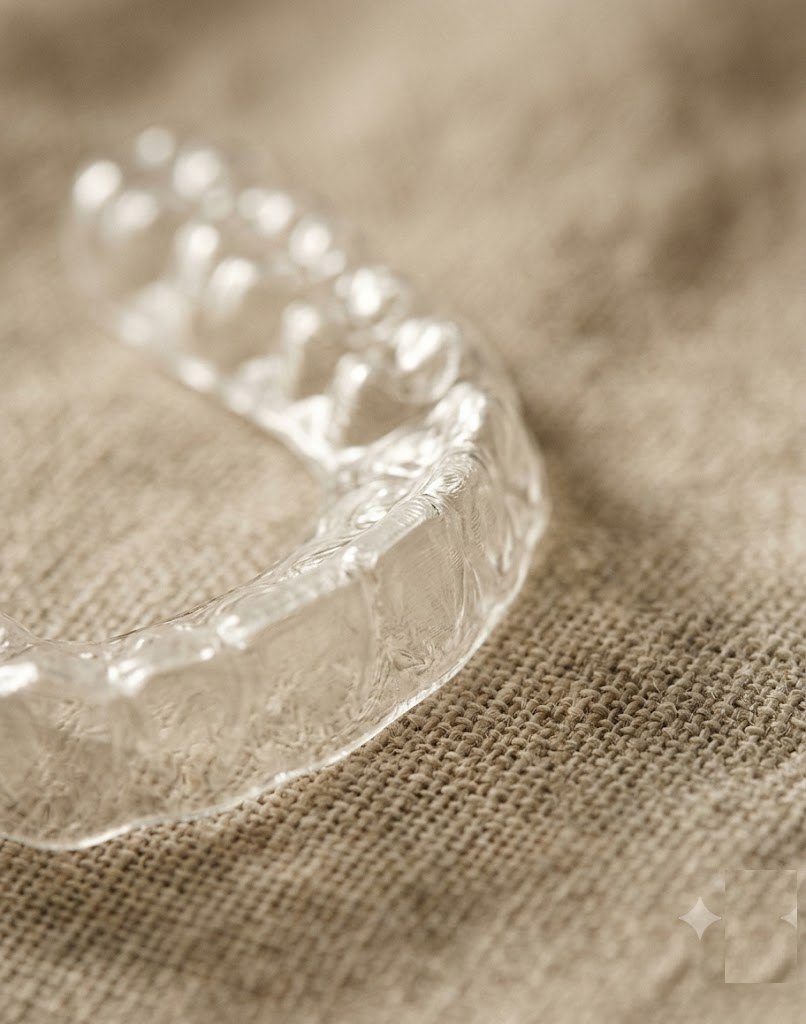
Of everything dentistry puts in a mouth, the retainer has the most extreme exposure profile. An aligner tray is swapped every one to two weeks — each tray's wear is capped. A filling is hard and abrades slowly. A retainer is one piece of thermoplastic — usually PET-G or similar — worn night after night for years, warmed to body temperature, bathed in saliva, flexed on and off daily, scrubbed, dropped, and occasionally rinsed in water hot enough to soften it. Every one of those is a release mechanism.
The research base has caught up recently. A 2025 review in Progress in Orthodontics (Shariff et al.) summarised what orthodontic thermoplastics shed under simulated wear: micro- and nanoplastic particles, released through abrasion and degradation, swallowed in saliva, with the smallest particles capable of crossing the gut lining. A 2025 review in the Journal of Hazardous Materials reached the same structural conclusion across dental plastics generally — release is real and driven by exactly the mechanisms a retainer experiences nightly. What no standard manufacturer provides is the number that matters: what does this retainer release? They don't test, or they don't publish.
Old retainers shed more
Wear compounds the problem. An aging retainer's surface roughens — micro-scratches from cleaning, crazing from heat, bite wear — and rough surfaces shed more than smooth ones. The device is also harder to keep hygienic as it degrades. This is why replacement schedules exist, and why running a retainer "until it breaks" — which is what most people do, because replacements from a practice are expensive — quietly maximises exposure from the very years when the device is shedding most.
What actually reduces the exposure
Three things, in order of impact. Material: a retainer that isn't petroleum-based plastic changes the question entirely — you can't shed petro-plastic particles you aren't wearing. Evidence: a maker who tests each production lot with an independent laboratory and publishes the result replaces "trust the label" with "read the number." Freshness: replacing the retainer annually keeps you on the smooth, early part of the wear curve instead of the roughened end of it.
Why we built bio.retainers this way
Those three points are, in order, the design brief for bio.retainers. The material is a bio-derived polymer, not petroleum plastic. Every lot is tested by an ISO 17025-accredited independent laboratory for microplastic and BPA-derivative release, with results published at the bio. Standard — you can read the report for the batch your retainer came from. And the annual subscription (£154/year) exists precisely because of the wear curve: a fresh, tested retainer every year costs less than a single practice replacement, and it means you're never wearing a five-year-old device at the rough end of its life. First set from £110; included free with every bio.aligners treatment.
We can't tell you what your current retainer releases — nobody can, because nobody measured it. We can tell you exactly what ours does. That's the difference.
Related reading: What are dental retainers made of? · How often should you replace your retainer?
The retainer you can read the results for.
Bio-derived material. Independent testing on every lot. A fresh retainer every year from £154 — less than one practice replacement.