Plastic-free dentistry: an honest guide.
Almost everything dentistry puts in your mouth is plastic — the brush, the floss, the aligner, the retainer. Here's what "plastic-free" genuinely means for each, what the research says about wear and shedding, and where the honest limits are.
Start with an uncomfortable fact
Your toothbrush has plastic bristles on a plastic handle. Your floss is a plastic thread in a plastic box. Toothpaste comes in a layered plastic tube — and often contained plastic microbeads until they were banned in rinse-off products. If you wear a retainer or clear aligner, that's a sheet of thermoplastic or polyurethane held against your teeth for hours every day. Dentistry runs on plastic, and until recently almost nobody asked what that means for the body wearing it.
The research is now catching up. A 2025 review in Progress in Orthodontics (Shariff et al.) summarised what orthodontic plastics release under simulated wear: micro- and nanoplastic particles, shed through abrasion and swallowed in saliva, with the finest particles small enough to cross the gut lining. Separate laboratory work has found cytotoxicity in a majority of leading plastic aligner materials tested. None of this means panic; it means the question is legitimate — and that "plastic-free" is worth understanding properly rather than as a marketing sticker.
The easy swaps: brush, floss, paste
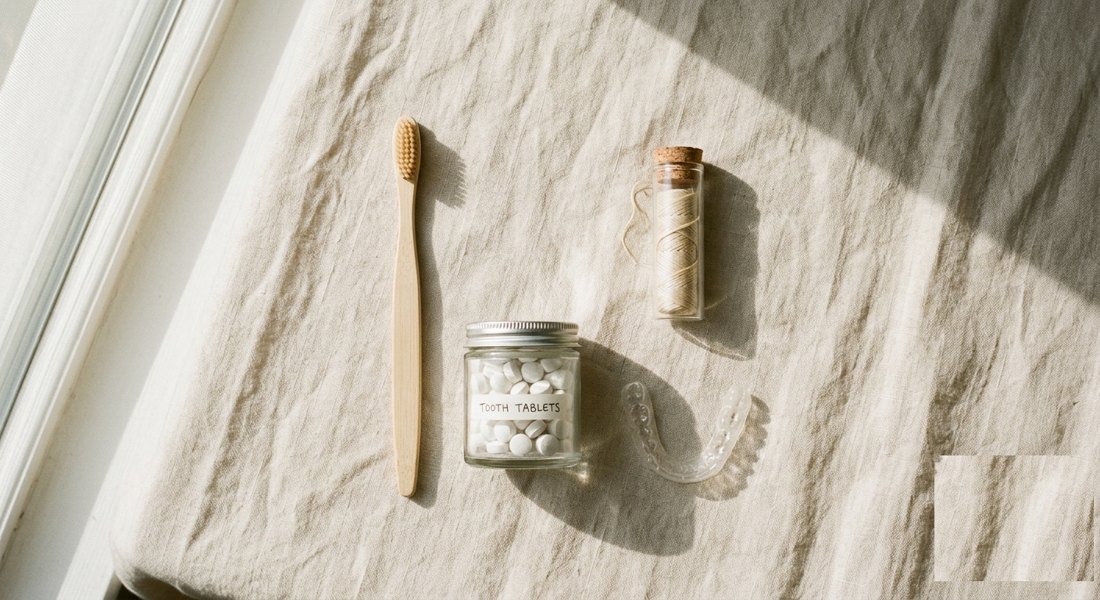
This is where plastic-free dentistry is most mature. Bamboo-handled brushes with plant-based bristles, floss made from silk or plant fibre in glass or cardboard packaging, and toothpaste tablets in aluminium jars all exist and work. Two honest cautions: some "bamboo" floss is actually polyester (a plastic) — check the fibre, not the packaging — and bristles are the hardest part to make truly plastic-free, so many bamboo brushes still use nylon. These swaps mainly reduce plastic waste; your exposure from a toothbrush is brief and rinsed away.
The hard part: what stays in your mouth
Exposure is a function of contact time. A brush touches your teeth for four minutes a day. A retainer is worn roughly eight hours a night, often for decades. A clear aligner is worn 20–22 hours a day for months. If plastic shedding in the mouth matters anywhere, it matters most in the devices with the longest contact — and those are precisely the products where plastic-free options have been rarest.
Almost every retainer in the UK is PET-G or a similar thermoplastic. Almost every clear aligner is a polyurethane copolymer. Manufacturers are not required to publish what these shed during wear, and almost none do. That's the gap bio. was built to close: bio.retainers are made from a bio-derived polymer and independently tested for microplastic release lot by lot, and bio.aligners are the only clear aligner in the UK made from a plant-based, BPA-free material rather than petroleum plastic — with every result published at the bio. Standard.
What "plastic-free" can and can't mean
Honesty matters here, because the phrase gets abused. No orthodontic device is made of thin air: "plastic-free" in dentistry properly means free from petroleum-based plastics and their associated chemistry — BPA and its derivatives, phthalates, plasticisers — replaced with plant-derived polymers. It should also mean the maker can show you testing rather than asking you to take the label on faith. If a brand claims plastic-free and publishes nothing, treat it as a slogan.
The questions worth asking of any dental device: What is the material, specifically? Is it petroleum-derived? Is it BPA-, latex- and phthalate-free — and says who? Has it been independently tested for what it releases during wear, and are those results public? A maker with good answers will volunteer them.
A realistic plastic-free routine, ranked by impact
If you're reducing plastic in your dental life, order of impact: first, the devices worn longest — retainer, aligner, nightguard — because contact time drives exposure; second, toothpaste and floss, which are swallowed-adjacent daily; third, the brush, which is mostly a waste issue. Perfection isn't available yet — bio.bond, a plastic-free restorative material, is still in development — but the highest-exposure items now have genuine alternatives, tested in the open.
Related reading: What are dental retainers made of? · Microplastics and clear aligners: what the research says